Health care

We provide affordable and personalized care

How can we help?

Helpful links

Financial

Accounts to help you save and pay for health care expenses

How can we help?

Helpful links

  • Resources

    Find contribution limits, savings tools, calculators and eligible expenses

  • Account support

    Find contact information and frequently asked questions

Tax season resources

Get ready for HSA tax season

If you used an HSA this year, the HSA Tax Center offers general information about contributions, eligible expenses and commonly used tax forms — all in one place.

Pharmacy

We make it easy to get medications you need, when and where you need them

How can we help?

Helpful links

  • Optum Rx

    For people with pharmacy insurance benefits through Optum Rx

  • Track orders

    Track your home delivery and specialty order

  • Pharmacy support

    Find contact information and answers to frequently asked questions

Mobile app

Optum Rx on the go

Request refills, track order status, manage billing information and much more.

Download on the App StoreGet it on Google Play

Article

How to read your prescription label

Get to know your Optum Home Delivery Pharmacy and Optum Specialty Pharmacy prescription label.

May 29, 2026 | 6-minute read

In this article

Knowing how to read a prescription label can make managing your medication feel less overwhelming. Optum® Home Delivery Pharmacy and Optum® Specialty Pharmacy design their label to give you the information you need without unnecessary clutter, so you can quickly understand: 

  • How much to take 
  • When to take it 
  • Important safety steps  

When you know what each part of the label means, it’s easier to feel confident and stay on track with your medication. 

What do the different sections of a prescription label mean? 

Learn your way around the Optum Home Delivery and Optum Specialty Pharmacy prescription label. This quick guide can help.

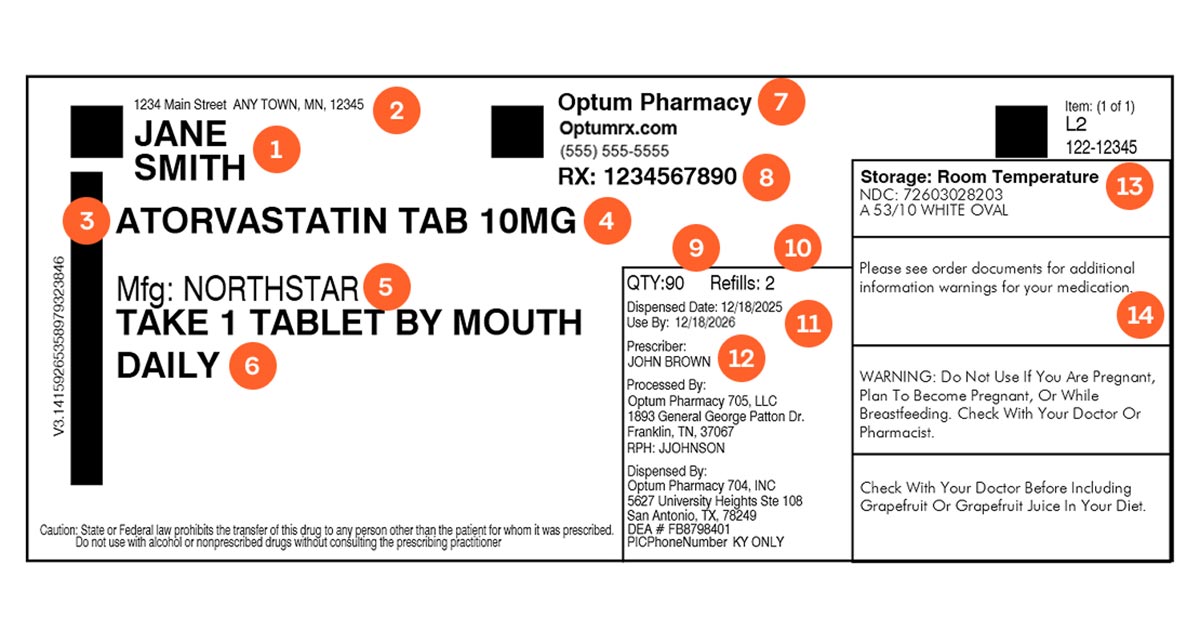
Example of a prescription label from Optum Home Delivery and Optum Specialty Pharmacy. There are numbered annotations that correspond to the text that follows in the body of the article.

Match each number to its place on the sample prescription label.

1. Patient name  
The name of the person the medication is prescribed to  

2. Patient address  
The patient’s primary address on file with Optum Home Delivery and Optum Specialty Pharmacy 

3. Medication name  
The brand or generic/chemical name of the prescribed medication  

4. Medication strength  
The amount of active drug in each tablet, capsule or dosage unit written right after the medication name 

5. Manufacturer  
The company that made the medication 

6. Instructions for use  
How much medication to take, how to take it and how often 

7. Pharmacy information  
The name of the Optum pharmacy that filled the prescription and a phone number patients can call with questions about their medication  

8. Prescription number  
A unique code that identifies the prescription and makes it easier to request a refill 

9. Medication quantity   
The amount of medication dispensed  

10. Refills  
The number of refills remaining before the prescription expiration date 

11. Use-by date  
The date the medication expires and should be safely discarded  

12. Prescriber  
The name of the provider who wrote the prescription 

13. Storage  
How to store the medication to keep it safe and effective until its use-by date  

14. Warning labels  
Any additional safety notes needed to direct route of use, timing and administration, safety and side effects, storage and handling or other legal requirements


Do Optum Home Delivery and Optum Specialty Pharmacy  have unique prescription labels? 

The format is unique, but the information isn’t. And that’s by design. For your safety, state and federal laws determine what must appear on a prescription label and, in some cases, where it appears on the label.1

Optum Home Delivery and Optum Specialty Pharmacy designed their prescription label with these rules — and other design best practices — in mind. The goal is to help you take your medication and refill your prescriptions with ease.  

Do retail pharmacy prescription labels differ from mail-order medication labels? 

Yes, they can. Retail and mail‑order pharmacies often use different label templates. That means labels can vary in both format and, in some cases, content.  Mail‑order pharmacies, like Optum Home Delivery Pharmacy and Optum Specialty Pharmacy, typically ship medications nationwide to all 50 states. 

Because of this, their labels may include additional information to meet the requirements of multiple state laws. Retail pharmacies, on the other hand, often operate within a single state and may only include information required by that state. 

That said, the most important information — such as the patient’s name, medication name, directions for use and safety information — will always be on the label.

What prescription label features help avoid confusion with similar medications?

Look-alike, sound-alike medications are medications that have similar names, colors, shapes, sizes and/or packaging.To avoid confusion and help keep you safe, Optum Home Delivery and Optum Specialty Pharmacy may use one or more of the following design techniques: 

  • Tall man lettering: Parts of the drug name are written in uppercase to highlight differences. For example, vinBLAstine vs. vinCRIstine 
  • Bold text: Labels use boldface to draw your eye to differences. 
  • Both brand and generic names: Labels list both versions of a medication name. 

Together, these design choices can help you feel confident you’re taking the medication your provider intended — no guesswork needed. 

What types of warnings do I need to look out for on prescription labels?

Warnings on prescription labels are short, attention‑grabbing messages that help people use their medication safely and correctly. These warnings can look like small boxes, stickers or callouts on the prescription label or package. The wording and/or design can vary by medication and pharmacy.3,4  

The most common types of warnings you’ll see on Optum Home Delivery and Optum Specialty Pharmacy prescription labels are related to: 

  • Drug identification: Used to help patients correctly identify their medication, especially when the appearance of a medication has changed. Typically, the letters and/or numbers on the tablet or capsule, color and shape will be listed. 
  • Timing and administration: Guides when and how to take the medication. For example, “Take with food.” 
  • Storage and handling: Explains how to protect medication quality and ensure safe handling. For example, “Keep in refrigerator.”  
  • Safety and side effects: Calls out potential risk or interactions. For example, “May cause drowsiness. Or, “Do not take with alcohol.” 

Any warnings that don’t fit on the label will be included in the printed information you receive with your prescription medication. 

What prescription labels are available for people with visual impairments?

People with visual impairments can ask for accessible accommodations that make medication information easier to read or hear.5 Options may include large print materials, braille labels and talking (meaning audible) labels.  

  1. Electronic Code of Federal Regulations. 21 CFR §201.57(c)(1): Specific requirements on content and format of labeling for human prescription drug and biological products. Updated February 23, 2026.  
  2. World Health Organization. Medication safety for look‑alike, sound‑alike medicines. Published October 20, 2023.  
  3.  Electronic Code of Federal Regulations. 21 CFR §1306.14: Labeling of substances and filling of prescriptions. Updated February 23, 2026.  
  4.  United Ad Label. Pharmacy auxiliary labels. Accessed February 26, 2026.  
  5.  U.S. Access Board. Accessible prescription drug labeling. Accessed February 26, 2026. 

*The prescription label shown is for illustrative purposes only. It does not represent a real patient nor prescription.